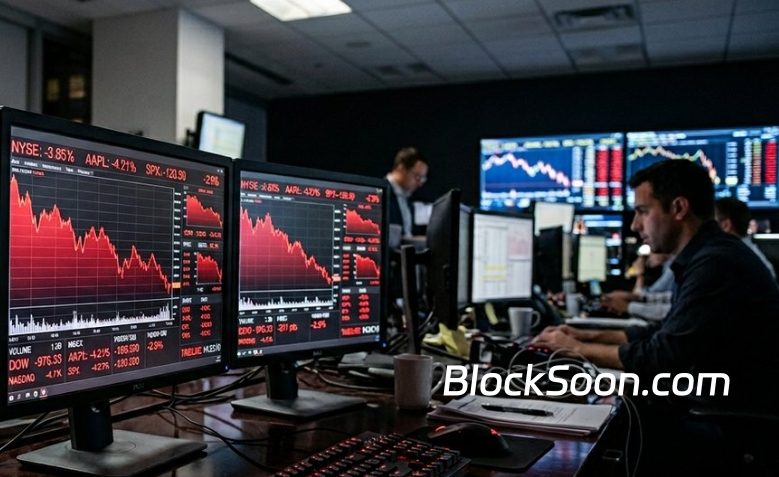
I’ve been looking at European equities today and I keep coming back to one simple feeling: no one is really in control of direction right now.
It’s not a crash in Europe.




It’s not a rally either.
It’s something more uncomfortable — hesitation created by external pressure.
When global technology stocks get hit hard and the tone from the Federal Reserve stays firmly hawkish, Europe doesn’t get to trade its own story.
It gets pulled into someone else’s narrative.
And that’s exactly what I think we’re seeing in STOXX Europe 600 and regional benchmarks like DAX Index.
The real driver isn’t Europe itself
I don’t think European fundamentals suddenly deteriorated this week.
What changed is the external pressure system.
Two forces are doing most of the work:
- Global technology selloff resetting risk appetite
- A persistent hawkish tone from the Federal Reserve
And when those two combine, Europe becomes a receiver of volatility rather than a source of it.
That’s important.
Because it explains why direction is so inconsistent.
I keep thinking about how global tech broke the rhythm
The sharp decline in global technology stocks didn’t stay contained in the US.
It spilled directly into European risk sentiment.
Even though Europe is less AI-concentrated than US indices, it still gets hit through:
- Global ETF flows
- Cross-asset risk de-risking
- Correlation spikes during volatility events
So when US tech sells off aggressively, European equities don’t ask questions.
They just reprice.
A quick conversation I had this morning
Me: Europe feels stuck.
Friend: It’s not stuck. It’s reacting to everything else.
Me: But there’s no clean direction.
Friend: That’s the point. There’s no dominant driver right now.
Me: So what moves it then?
Friend: Whatever the US does next.
That line stuck with me more than anything else today.
Because it highlights a structural issue in global markets right now: leadership is external, not internal.
Why the Fed matters more than usual
The hawkish stance from the Federal Reserve isn’t new, but its impact feels more intense now.
Not because rates changed this week.
But because expectations shifted.
Markets are now reacting faster to:
- Any delay in rate-cut expectations
- Any signal of sticky inflation
- Any comment reinforcing higher-for-longer policy
And that changes everything for risk assets globally.
Including Europe.
Because valuation sensitivity increases when discount rates stop being a background variable and become the main storyline again.
Europe’s internal split is telling me something
What I find interesting is not just the index level.
It’s the dispersion underneath.
Some sectors are holding up better than others:
- Defensive healthcare and staples showing relative stability
- Banks still supported by yield structure
- Luxury and cyclicals under pressure from global demand concerns
- Tech-adjacent names reacting sharply to US sentiment
This is not a uniform move.
It’s a rotation under stress.
And that usually signals uncertainty rather than conviction.
I want to be very clear about what this is not
This is not a European-specific crisis.
I don’t see a domestic shock inside Europe driving this.
What I see instead is:
- Imported volatility
- Policy-driven repricing
- Global correlation spikes
It feels like Europe is being used as a barometer for global risk appetite rather than acting as its own engine.
Another thing I noticed in flows
There’s a subtle but important shift happening in positioning:
- Reduced appetite for high beta exposure
- Slight rotation toward dividend-heavy European names
- Increased hedging activity in index products
- Lower conviction in directional bets
None of this screams panic.
But it does scream caution.
And caution is enough to flatten markets even without a catalyst.
The part most people underestimate
When global tech sells off, it doesn’t just impact tech sectors.
It compresses liquidity across the entire equity complex.
That means:
- Lower risk tolerance
- Faster profit-taking
- Less willingness to buy dips
- Higher sensitivity to macro headlines
And once that environment forms, Europe doesn’t escape it.
It just expresses it differently.
A simple way I frame the current situation
I keep asking myself:
What is actually driving price discovery right now?
And the honest answer is:
Not earnings.
Not growth revisions.
Not regional fundamentals.
It’s positioning and macro tone.
That’s why indices feel directionless.
Because they are reacting instead of leading.
What would change my view
I’m watching a few things closely:
- Stabilization in global tech leadership
- Any softening in Federal Reserve rhetoric
- Return of consistent dip buying in European equities
- Compression in volatility indices
If those align, direction returns quickly.
If they don’t, we stay in this choppy, headline-driven environment.
Final thought
European stocks are not broken.
But they are currently being steered by external forces that are louder than internal fundamentals.
Global technology volatility sets the temperature.
The Federal Reserve sets the pressure.
And Europe sits in between, trying to find direction in a room where the lights keep flickering.
That’s the environment I’m watching now.
Not a trend.
Not a collapse.
Just a market searching for a dominant signal again.